
Real-time stem separation has fundamentally transformed modern DJ performance. Tools like Serato Stems, Rekordbox Track Separation, and VirtualDJ Modern Stems allow DJs to instantly isolate acapellas, mute drum breaks, and swap basslines on the fly during live multi-deck sets.
However, many DJs notice that when isolating vocals or drums on certain tracks, the audio takes on an unpleasant 'underwater' sound with phase swishing, robotic artifacts, and hollow low-end frequencies. This problem is not caused by the DJ software, but by the underlying audio file format.
In this technical deep dive, we explore how neural network audio de-mixing algorithms operate, explain why MP3 compression corrupts frequency isolation masks, and demonstrate why 24-bit Lossless FLAC from beatport-downloader.com is essential for pristine, artifact-free stem performance.
1. How Real-Time AI Stem Separation Works
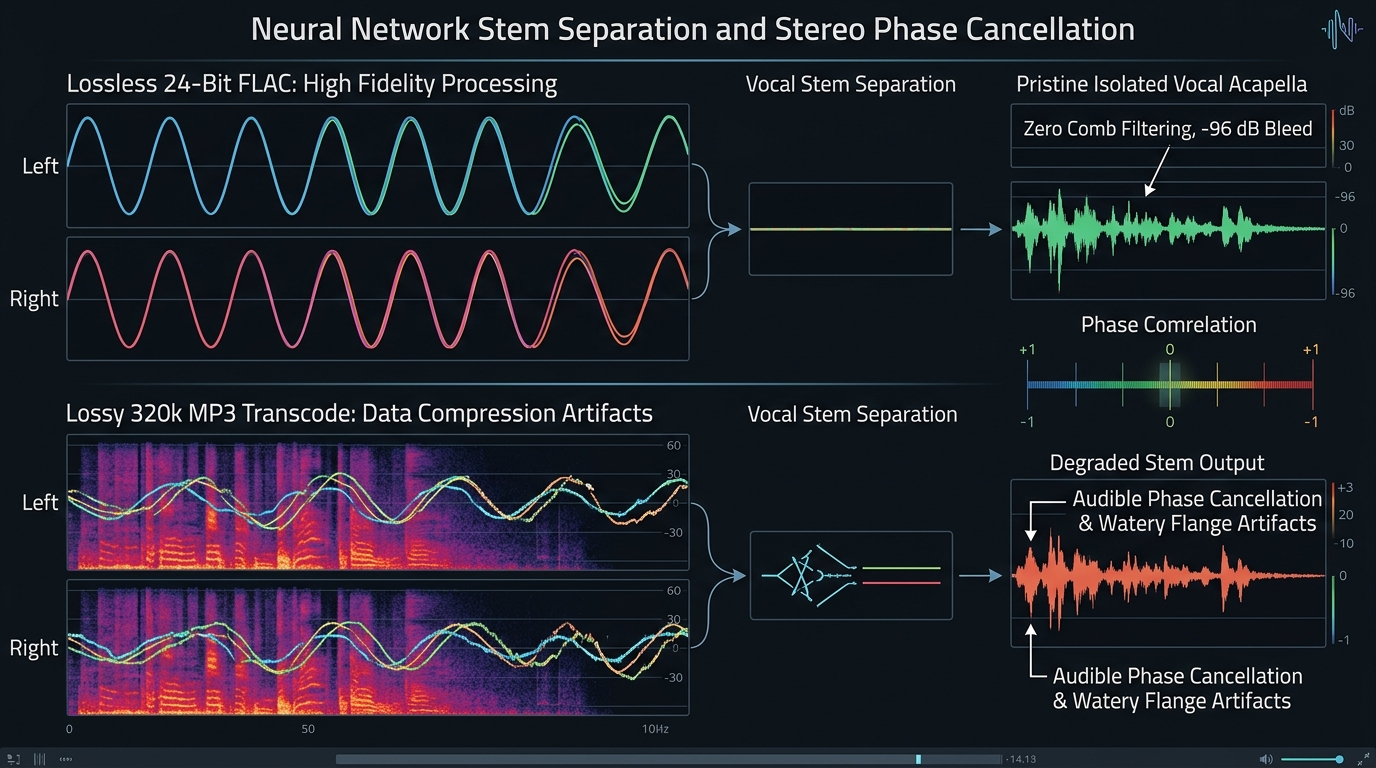
Real-time stem extraction is powered by deep neural networks trained on multitrack studio recordings. Here is the step-by-step DSP pipeline:
- ✦Short-Time Fourier Transform (STFT): The software converts incoming digital audio into a 2D time-frequency spectrogram representing energy distribution across all frequencies.
- ✦Neural Network Inference (U-Net Architecture): The AI model evaluates harmonic patterns, transient attacks, and formant structures to estimate the probability that each pixel in the spectrogram belongs to vocals, drums, bass, or instruments.
- ✦Dynamic Spectral Masking: The engine applies time-varying soft gain masks across thousands of frequency bins.
- ✦Inverse Fast Fourier Transform (iFFT): The masked spectrogram is transformed back into an audible time-domain waveform in real time.
The Neural Stem Separation Pipeline:
┌────────────────────────────────────────────────────────┐
│ Input Audio Stream (WAV / FLAC / MP3)                  │
└──────────────────────────┬─────────────────────────────┘
                           │ 1. STFT Spectrogram Conversion
                           ▼
┌────────────────────────────────────────────────────────┐
│ Deep Neural Network (Demucs / U-Net Inference)         │
│ ├── Harmonic Formant Identification (Vocals)           │
│ ├── Fast Transient Attack Detection (Drums)            │
│ └── Sub-Bass Fundamental Tracking (Bassline)           │
└──────────────────────────┬─────────────────────────────┘
                           │ 2. Dynamic Spectral Masking
                           ▼
┌───────────────┬───────────────┬───────────────┬───────────────┐
│ Vocal Stem    │ Drum Stem     │ Bass Stem     │ Synth Stem    │
│ (Acapella)    │ (Percussion)  │ (Sub / Mid)   │ (Harmonics)   │
└───────────────┴───────────────┴───────────────┴───────────────┘
2. Why MP3 Compression Corrupts Stem De-Mixing
To understand why lossy files fail during stem extraction, we must examine how MP3 compression discards data:
1. Modified Discrete Cosine Transform (MDCT) Quantization: MP3 encoders divide audio into 32 frequency sub-bands and discard subtle spectral details that human hearing normally ignores when louder sounds occur simultaneously (psychoacoustic masking).
2. Joint Stereo Phase Blurring: To save bitrate, MP3 encoders merge stereo channels above 10 kHz into a single combined channel with panning metadata. Joint-stereo encoding (M/S stereo and intensity stereo) can approximate high-frequency directional cues to save bandwidth, which reduces independent phase precision between stereo channels under neural source separation.
When the neural de-mixing model tries to isolate a vocal acapella from an MP3, it encounters quantized frequency holes and blurred stereo phase data. The model cannot cleanly separate vocal formants from underlying synths, creating audible 'swishing' artifacts and robotic warble.
3. Sub-Bass Phase Alignment in Live DJ Transitions
During a live electronic music transition, sub-bass frequencies (30 Hz to 90 Hz) carry enormous acoustic energy. When you isolate the bassline of Track A and blend it with the kick drum of Track B:
- ✦With Lossless 24-Bit FLAC: Low-end transient phases remain razor-sharp. The kick drum transient punches cleanly through the sound system without smearing the sub-bass foundation.
- ✦With Compressed MP3: Phase distortion in the lower sub-bands causes constructive and destructive comb filtering. When two decks overlap, the low end frequently drops in volume or sounds boomy and undefined.
| Audio Source Format | Vocal Isolation Clarity | Transient Snappiness (Drums) | Sub-Bass Phase Coherence | Artifact Resistance |
|---|---|---|---|---|
| **YouTube / Rip (128k)** | Severe underwater warble | Muffled, smeared attacks | Phase cancellation, weak sub | Unusable in club sets |
| **320kbps CBR MP3** | Acceptable (mild gating artifacting) | Preserved main transients | Audibly stable (minor phase jitter) | Suitable for standard playback; mild separation artifacts |
| **24-Bit Lossless FLAC** | **Optimal spectral mask accuracy** | **Fully preserved transients** | **Intact waveform phase coherence** | **Maximum headroom for live isolation & processing** |
4. Performance Tips for Live Stem Mixing
- ✦Pre-Analyze Stems in Rekordbox/Serato: In software preferences, enable offline stem preparation for your performance playlists. This pre-computes neural isolation masks on your SSD so your CPU does not spike during live sets.
- ✦Use Source-Quality FLAC Files: Building your crates with 24-bit FLAC from beatport-downloader.com provides intact spectral bins, ensuring isolated vocal acapellas sound as clean as dedicated studio multitracks.
- ✦High-Pass Filter Isolated Elements: When isolating a vocal stem, apply a high-pass filter around 120 Hz to eliminate residual low-end rumble from the original master.
Lift Your Live Stem Performance
Don't let lossy compression artifacts undermine your creative transitions. Download pristine 24-bit lossless FLAC masters for clean, studio-grade real-time stem isolations.