
Every new DJ runs into the exact same problem when starting out: you want a great library with plenty of variety, but buying every single song individually at two or three dollars each gets expensive very fast. If you try to buy three hundred songs on your first day, you will easily spend as much money as a brand-new controller costs. On the flip side, relying on low-quality YouTube rips or free download links will leave your mixes sounding muddy and flat as soon as you plug into larger sound systems. The smart solution that working DJs rely on is hybrid DJ music sourcing.
In simple terms, hybrid DJ music sourcing means combining a flat-rate subscription service (a record pool) for the bulk of your library with carefully chosen, high-quality lossless purchases from stores like Beatport and Traxsource for your biggest tracks. This approach gives you the volume you need to play long sets while keeping your audio quality high where it matters most, all while staying within a sensible monthly budget.
1. Understanding the Core Platforms: Pools vs. Digital Retail Stores
Let us first break down how the different platforms work. When you are just getting started, the terminology can be confusing, but each service plays a specific role in your collection.
What Is a Record Pool?
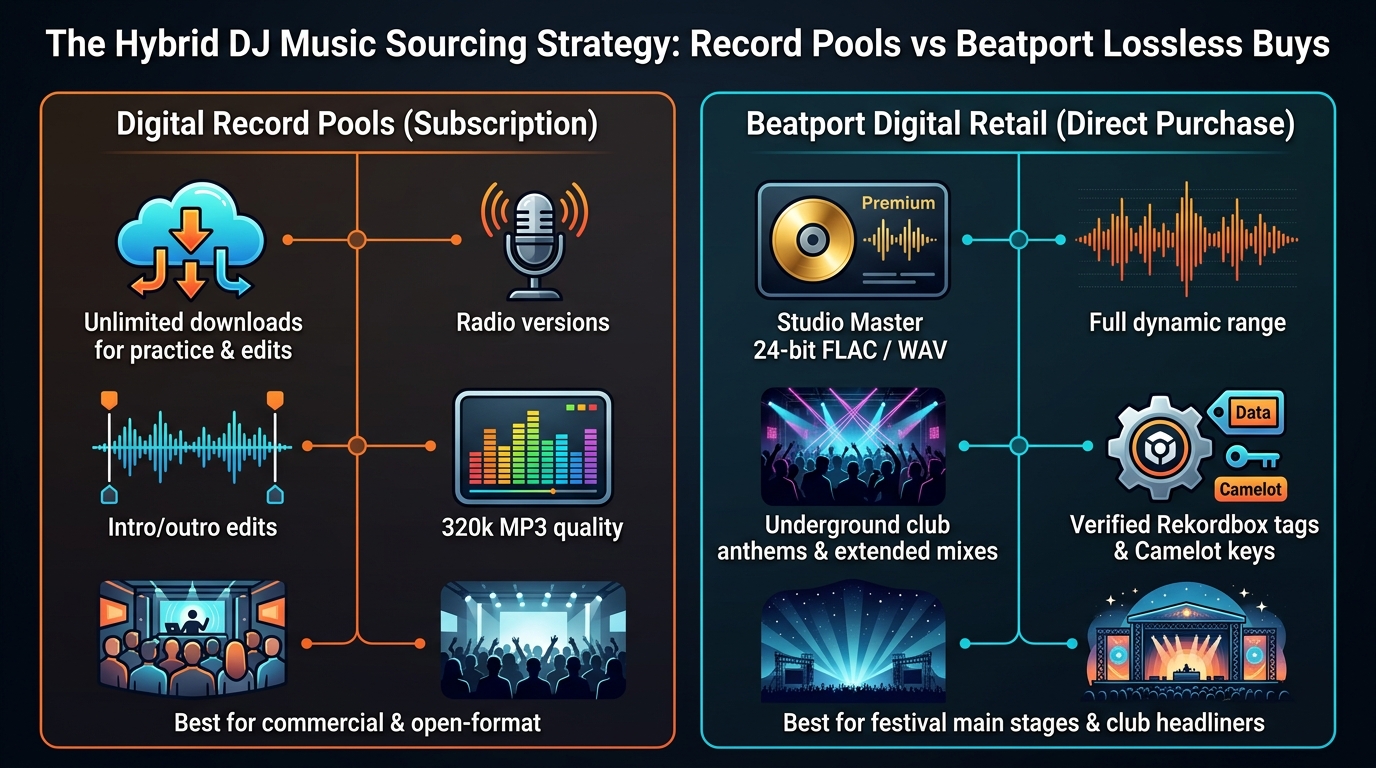
A record pool is a monthly promotional music subscription made specifically for working DJs. Services like BPM Supreme, DJcity, Crate Connect, and ZipDJ charge a flat monthly fee—usually between twenty and forty dollars. In exchange, you get unlimited downloads from their entire catalog.
Record pools work directly with music labels to help promote new releases in clubs and on radio stations. Because of this promotional relationship, pools do not just give you the standard radio edit of a track. They provide specialized versions crafted for DJ mixing:
- ✦Extended Mixes & Intro Edits: Tracks that start and end with 8 or 16 bars of clean drums, giving you plenty of time to beatmatch and blend smoothly.
- ✦Short Edits & Quick Hits: Shortened versions that cut straight to the verse and chorus, perfect for fast-paced party sets.
- ✦Acapellas & Instrumentals: Isolated vocals and backing beats that let you create live mashups and unique transitions on the fly.
- ✦Transition Tracks: Custom edits that gradually speed up or slow down, helping you switch between different tempos without awkward gaps.
Almost every record pool supplies their files in 320kbps MP3 format. The number 320 refers to the bitrate—the amount of digital data processed per second. At 320 kilobits per second, an MP3 provides solid fidelity for home practice, house parties, mobile gigs, and standard bar setups. It gives you good sound quality while keeping file sizes small (around 10 megabytes per song).
What Are Beatport and Traxsource?
By comparison, Beatport and Traxsource are digital retail music stores. Instead of paying a flat subscription, you buy tracks one by one. Prices typically range from $1.49 to $2.99 per song depending on the audio format you choose.
These stores are the primary home for underground electronic music, spanning genres like tech house, melodic techno, deep house, trance, and drum & bass. Most importantly, digital stores give you access to true lossless audio formats, such as 24-bit FLAC, AIFF, and WAV.
2. What Does "Lossless" Mean in Plain English?
To understand why lossless audio matters, think of an MP3 file like a compressed photo. When an audio file is converted into an MP3, an algorithm strips out tiny acoustic details that most people do not notice when listening through basic phone speakers or earbuds. This compression process shrinks the file so it downloads quickly.
A lossless file (like FLAC or WAV) keeps 100% of the original studio recording data without throwing away any musical information. In our 24-bit FLAC vs 320kbps MP3 sound quality test, we show how lossless files deliver punchier sub-bass dynamics and cleaner high frequencies on large club horn systems without high-volume distortion.
| Feature | Record Pool (e.g., BPM Supreme, ZipDJ) | Digital Store (Beatport / Traxsource) |
|---|---|---|
| Pricing Model | Flat subscription ($20 – $40 / month) | Pay per track ($1.49 – $2.99 / track) |
| Download Volume | Unlimited or high allowance | Single track purchases |
| Audio Quality | 320kbps MP3 (Lossy compressed) | 24-bit FLAC / AIFF / WAV (Lossless Master) |
| Crate Role | Warmup tracks, edits, throwbacks, remixes | Signature bangers, peak-time drops, exclusive IDs |
| Catalog Strength | Commercial hits, club edits, open-format | Underground club genres, label discographies |
3. The Hybrid Decision Filter: When to Pool vs. When to Buy Lossless
Once you understand the difference between compressed pool tracks and lossless store purchases, you can set up a clear decision process. You do not need to buy every song in lossless format, and you should not rely solely on MP3s for your key peak-time anthems. Here is a simple three-question filter to use whenever you find a new track:
Question 1: Is this a signature peak-time anthem in my set?
If a song is the emotional high point of your set—the track everyone waits for, or the heaviest drop of the night—buy the lossless version on Beatport or Traxsource. When you play that track at high volume on a club system, the extra dynamic range and clean sub-bass will make your set sound powerful and clear.
Question 2: Is this an intro edit, transition tool, or early warmup track?
If you need an edit with an extended 16-bar drum intro, a clean vocal acapella, or a selection of background grooves to warm up the room as guests arrive, grab them from your record pool. 320kbps MP3s sound great at moderate volumes and will save you hundreds of dollars over the course of a year.
Question 3: Is this track an exclusive release from an underground record label?
Many specialized electronic labels do not upload their releases to mainstream record pools. When you are looking at Traxsource vs record pool or comparing record pool + Beatport options, you will find that underground dance music is often exclusive to digital stores. When a track is only available on Beatport or Traxsource, buying it directly ensures you get the track while supporting the independent artist and label who created it.
4. A Realistic $50 Monthly DJ Budget Blueprint
You do not need a big budget to build a professional collection. Here is a practical plan showing how you can get lossless tracks on a budget for about fifty dollars a month:
SAMPLE $50 MONTHLY HYBRID MUSIC BUDGET:
================================================================================
1. Record Pool Subscription (BPM Supreme / Crate Connect) : $29.99 / month
   - Download Yield: 50 to 120 tracks (Intro edits, transition tools, acapellas)
   - Cost Per Track: ~ $0.25 to $0.50

2. Selective Lossless Purchases (Beatport / Traxsource)  : $20.00 / month
   - Download Yield: 8 to 10 pristine 24-bit FLAC / WAV peak-time masters
   - Cost Per Track: ~ $2.00 to $2.50
================================================================================
TOTAL MONTHLY INVESTMENT : ~$50.00
TOTAL NEW MONTHLY TRACKS : 60 to 130 high-grade songs ready for gig performance
================================================================================
Following this 70/30 balance means you add dozens of versatile mixing tools each month without sacrificing studio-grade fidelity on your biggest tracks. In six months, you will have built a well-rounded library of over five hundred songs tailored for any party or club night.
5. Step-by-Step Starter Workflow for Your Next Gig
Ready to organize your music digging routine? Follow this straightforward step-by-step workflow every week:
- Step 1: Dig in Your Record Pool First: Start your weekly session on your pool. Grab the latest remixes, club edits with intro beats, and any throwback party tracks you need for upcoming weekend gigs.
- Step 2: Curate Your Beatport & Traxsource Wishlist: Listen through new label releases, Top 100 charts, and artist DJ charts. Add the absolute standout tracks to your shopping cart or crate.
- Step 3: Extract Lossless Masters with Beatport Downloader PRO: Open the Beatport Downloader PRO workstation to download your chosen tracks in studio-grade 24-bit FLAC. The app automatically injects clean album art and verified Camelot harmonic keys into every file.
- Step 4: Tag Harmonic Keys and BPM in Rekordbox: Drag your new tracks into Pioneer Rekordbox, Serato DJ Pro, or Engine DJ. If you ever run into missing key tags, check our guide on harmonic mixing and Camelot key tags to keep your crate sorted for seamless blends.
- Step 5: Export to a Clean USB Drive: Make sure your flash drive is formatted with the MBR FAT32 scheme. Review our walkthrough on formatting USB flash drives for Pioneer CDJs to avoid track loading glitches in the booth.
6. Your Next Step This Week
Building a dependable DJ library is a steady journey. You do not need thousands of tracks sitting on your laptop to play a great set. In fact, most working resident DJs perform their best sets with a tight crate of one hundred to two hundred songs they know inside and out.
Pick one record pool that matches your primary musical style, choose five standout tracks to purchase in lossless format this week, and start practicing your blends. You will immediately hear the difference in dynamic punch, and your wallet will thank you.
Get Studio Master 24-Bit FLAC Downloads
Download pristine 24-bit lossless FLAC files with auto Camelot key tagging, BPM detection, and full album artwork directly through Beatport Downloader PRO.
Try Beatport Downloader PRO Free